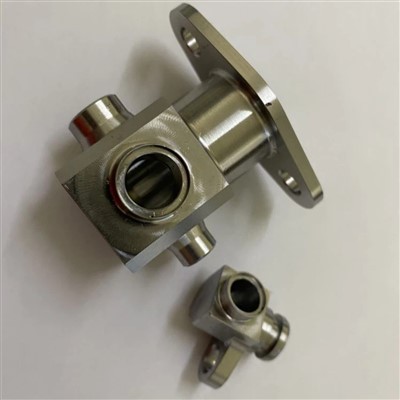
Semiconductor CNC components play a crucial role in the semiconductor manufacturing industry. As a leading supplier of Semiconductor CNC Components, I am often asked about the common assembly methods for these components. In this blog, I will share some of the most widely used assembly methods and their characteristics.
Solder Assembly
Solder assembly is one of the most common methods for joining semiconductor CNC components. It involves using a solder material, typically a tin - lead or lead - free alloy, to create a mechanical and electrical connection between the component and the printed circuit board (PCB).
The process starts with applying a solder paste to the PCB pads. The solder paste is a mixture of tiny solder particles and flux. Flux helps to clean the surfaces of the component and the PCB, removing oxides and promoting good wetting of the solder. After applying the solder paste, the components are placed on the PCB using pick - and - place machines. These machines are highly accurate and can place components with great precision.
Once the components are in place, the PCB is heated in a reflow oven. The temperature in the reflow oven is carefully controlled to reach the melting point of the solder, allowing it to flow and form a bond between the component and the PCB. The advantage of solder assembly is its high reliability and good electrical conductivity. It can also handle a large number of components on a single PCB, making it suitable for mass production. However, it requires precise temperature control during the reflow process to avoid issues such as solder bridges or cold joints.
Adhesive Bonding
Adhesive bonding is another important assembly method for semiconductor CNC components. It uses adhesives to bond components to the PCB or other substrates. Adhesives can provide mechanical support and, in some cases, electrical insulation.
There are different types of adhesives available, such as epoxy, acrylic, and silicone. Epoxy adhesives are known for their high strength and good chemical resistance. They are often used in applications where high reliability is required. Acrylic adhesives cure quickly and have good adhesion to a variety of materials. Silicone adhesives are flexible and can withstand high temperatures and vibrations.
The process of adhesive bonding involves applying the adhesive to either the component or the substrate, then bringing the two together and allowing the adhesive to cure. Curing can be achieved through heat, light, or chemical reactions. Adhesive bonding is a good option when solder assembly is not suitable, for example, when the components are sensitive to high temperatures or when a non - conductive bond is required.
Press - Fit Assembly
Press - fit assembly is a mechanical assembly method where components are inserted into holes or sockets on the PCB or other structures with a certain amount of force. This creates a tight and secure connection between the component and the substrate.
The advantage of press - fit assembly is that it does not require soldering or adhesives, which can simplify the assembly process and reduce the risk of thermal damage to the components. It also allows for easy disassembly and replacement of components if needed. However, it requires precise machining of the holes and components to ensure a proper fit. If the fit is too loose, the component may not be securely held in place, and if it is too tight, it can cause damage to the component or the substrate.
Wire Bonding
Wire bonding is a method used to create electrical connections between semiconductor chips and the PCB or other packages. It involves using thin wires, usually made of gold or aluminum, to connect the bond pads on the chip to the corresponding pads on the substrate.
The wire bonding process starts with attaching one end of the wire to the bond pad on the chip using a bonding tool. Then, the wire is stretched and attached to the corresponding pad on the substrate. There are two main types of wire bonding: ball bonding and wedge bonding. Ball bonding is more commonly used for gold wires, while wedge bonding is often used for aluminum wires.
Wire bonding is a reliable and widely used method for semiconductor assembly. It can provide high - speed electrical connections and is suitable for a variety of chip packages. However, it requires a high level of precision and is sensitive to factors such as wire tension and bonding force.
Surface Mount Technology (SMT)
Surface mount technology is a modern assembly method that has become very popular in the semiconductor industry. In SMT, components are mounted directly onto the surface of the PCB, rather than through holes as in traditional through - hole technology.
SMT components are smaller and lighter than through - hole components, which allows for higher component density on the PCB. The assembly process involves applying solder paste to the PCB pads, placing the components on the paste using pick - and - place machines, and then reflowing the solder in an oven. SMT offers several advantages, including reduced size, weight, and cost, as well as improved electrical performance.


Module Assembly
Module assembly involves combining multiple semiconductor CNC components into a single module. This can include components such as integrated circuits, resistors, capacitors, and connectors. The module is then tested and assembled into a larger system.
Module assembly allows for easier integration of different components and can improve the overall reliability and performance of the system. It also simplifies the manufacturing process by reducing the number of individual components that need to be assembled.
As a supplier of Semiconductor CNC Components, we offer a wide range of products and services related to these assembly methods. Our components are manufactured with high precision and quality, ensuring reliable performance in various applications. If you are interested in Semiconductor CNC Machining, Automotive Machined Components, or Packaging Machinery Components, we are here to provide you with the best solutions.
If you are looking for high - quality Semiconductor CNC Components and professional assembly services, please feel free to contact us for procurement and negotiation. We are committed to meeting your specific needs and providing you with the best products and services in the industry.
References
- "Microelectronics Packaging Handbook" by R. Tummala, E. Rymaszewski, and A. Klopfenstein.
- "Semiconductor Manufacturing Technology" by S. Wolf and R. N. Tauber.
- "Surface Mount Technology: Principles and Practice" by J. H. Lau.