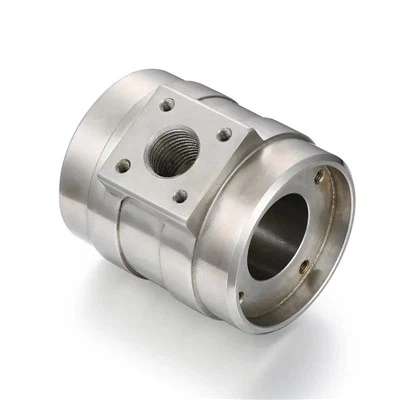
Acoustic emissions (AE) during the CNC machining of die castings are high-frequency stress waves generated by the rapid release of energy within a material due to deformation, fracture, or other internal changes. As a leading supplier of [CNC Machining Of Die Castings], we've delved deep into understanding these acoustic emissions and their implications. In this blog, we'll explore what acoustic emissions are during the CNC machining of die castings and what valuable information they can indicate.
Understanding Acoustic Emissions in CNC Machining of Die Castings
When we're engaged in the CNC machining of die castings, the cutting tools interact with the die - cast material. This interaction causes various mechanical phenomena, such as plastic deformation of the material, chip formation, and tool - workpiece friction. All these processes generate acoustic emissions.
Acoustic emissions are typically in the ultrasonic frequency range, usually from 20 kHz to 1 MHz. These high - frequency stress waves propagate through the material and can be detected by AE sensors placed on the machine or the workpiece. The AE signals are complex, consisting of a series of transient events, each representing a discrete energy release within the material.
Causes of Acoustic Emissions
1. Plastic Deformation
During CNC machining of die castings, the cutting tool exerts a significant force on the workpiece. This force causes the material to undergo plastic deformation. As the material deforms, dislocations within the crystal lattice move, interact, and multiply. These dislocation movements and interactions are sudden events that release energy in the form of acoustic emissions. For example, when the cutting tool starts to penetrate the die - cast material, the initial plastic deformation of the material generates a distinct set of AE signals.
2. Chip Formation
Chip formation is a critical aspect of CNC machining. As the cutting tool slices through the die - cast material, chips are formed. The processes of chip initiation, propagation, and separation from the workpiece are accompanied by energy releases. When the chip breaks away from the workpiece, it causes a sudden change in stress and generates a burst of acoustic emissions. The shape and type of chip (e.g., continuous, segmented, or discontinuous) can also affect the characteristics of the AE signals. Different die - cast materials may produce different chip types during machining, and thus, their corresponding AE signatures vary.
3. Tool - Workpiece Friction
The friction between the cutting tool and the die - cast workpiece is another major source of acoustic emissions. As the tool moves across the surface of the workpiece, rubbing occurs at the contact interface. This frictional force can cause micro - vibrations and local heating, leading to energy releases in the form of AE. The condition of the cutting tool, such as its sharpness and wear, significantly affects the magnitude and frequency content of the acoustic emissions due to friction. A worn - out tool may generate more intense and irregular AE signals compared to a sharp one.
What Do Acoustic Emissions Indicate?
1. Tool Condition Monitoring
One of the most important applications of monitoring acoustic emissions during the CNC machining of die castings is tool condition monitoring. By analyzing the AE signals, we can detect the early signs of tool wear or breakage. As a tool wears, the cutting forces increase, and the interaction between the tool and the workpiece becomes more intense. This change is reflected in the acoustic emissions. For instance, an increase in the amplitude and frequency of the AE signals may indicate that the tool is starting to wear. If there is a sudden spike in the AE signals, it could be a sign of tool breakage. By continuously monitoring the AE signals, we can replace the tool at the right time, preventing poor - quality machining and potential damage to the workpiece.
As a [CNC Machining Of Die Castings] supplier, we use advanced AE monitoring systems to keep a close eye on the tool condition. This ensures that we can maintain high - quality machining processes and deliver products like Precision Die - cast Aluminum Parts with consistent precision.
2. Workpiece Quality Assessment
Acoustic emissions can also provide valuable information about the quality of the machined die - cast parts. Irregularities in the AE signals may indicate defects in the workpiece, such as internal cracks or porosity. For example, if there are internal cracks in the die - cast material, the cutting tool may encounter sudden changes in the material's mechanical properties as it passes over the crack. This will cause abnormal AE signals, which can be detected and analyzed. By correlating the AE signals with the actual quality of the machined parts, we can develop quality control methods based on acoustic emission monitoring.
3. Machining Process Optimization
Understanding the relationship between acoustic emissions and the machining process parameters is crucial for process optimization. By adjusting parameters such as cutting speed, feed rate, and depth of cut, we can observe how the AE signals change. For example, increasing the cutting speed may lead to an increase in the frequency and amplitude of the AE signals due to higher cutting forces and more intense material deformation. By finding the optimal machining parameters that result in stable and low - intensity AE signals, we can improve the machining efficiency, reduce tool wear, and enhance the surface finish of the CNC Machined Parts.


4. Material Properties Detection
Different die - cast materials have distinct acoustic emission characteristics during machining. The AE signals can provide clues about the material's hardness, toughness, and microstructure. For example, a harder material may produce higher - frequency and more intense AE signals during plastic deformation compared to a softer material. By analyzing the AE signals, we can verify the material properties of the die - cast parts and ensure that they meet the required specifications. This is especially important when manufacturing complex CNC Machined Housing that need to withstand specific mechanical and environmental conditions.
Practical Applications in Our Business
As a supplier of CNC machining of die castings, we have integrated acoustic emission monitoring into our manufacturing processes. Our quality control teams use AE sensors to continuously monitor the machining operations. This real - time monitoring allows us to detect any potential issues early, whether it's tool wear, workpiece defects, or sub - optimal machining parameters.
For large - scale production orders, we can use the data collected from AE monitoring to optimize the production process. By minimizing tool changes and reducing the number of defective parts, we can improve our overall production efficiency and reduce costs. Additionally, our ability to provide high - quality [Precision Die - cast Aluminum Parts], [CNC Machined Parts], and [CNC Machined Housing] with consistent quality has earned us a good reputation in the market.
Conclusion
Acoustic emissions during the CNC machining of die castings are a rich source of information. They can be used for tool condition monitoring, workpiece quality assessment, machining process optimization, and material properties detection. As a supplier of [CNC Machining Of Die Castings], we recognize the importance of harnessing the power of acoustic emissions in our manufacturing processes. By leveraging this technology, we can ensure the highest quality of our products and provide better services to our customers.
If you're in the market for high - quality die - cast machining services, we welcome you to contact us for procurement and negotiation. We'll be glad to discuss your specific requirements and offer the best solutions for your projects.
References
- Schajer, G. S. (1988). Acoustic emission measurement and interpretation of plastic strain in metals. Journal of Testing and Evaluation, 16(1), 61 - 67.
- Pelletier, J. S., & Dornfeld, D. A. (1996). Acoustic emission monitoring of machining operations. Annals of the CIRP, 45(2), 587 - 606.
- Kline, W. A., & DeVries, A. N. (1973). Acoustic emission during metal cutting. Journal of Engineering for Industry, 95(3), 1009 - 1014.