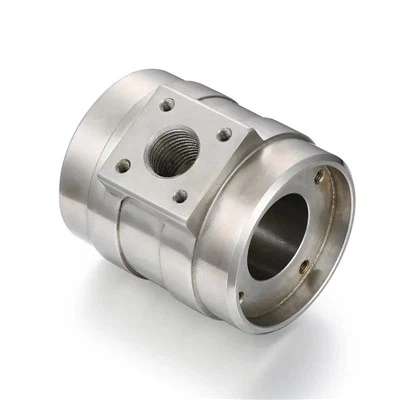
Electrochemical machining (ECM) is a non - traditional machining process that has gained significant importance in the field of mechanical processing components. As a supplier of mechanical processing components, I have witnessed firsthand the diverse and impactful applications of ECM in our industry.
1. Precision Machining of Complex Geometries
One of the most remarkable applications of ECM is in the precision machining of components with complex geometries. Traditional machining methods often struggle to produce parts with intricate shapes, sharp corners, and fine details. ECM, on the other hand, can easily handle such challenges. For example, in the production of CNC Machined Housing, which may have internal cavities, thin walls, and complex contours, ECM can achieve high - precision machining.
The principle of ECM is based on the anodic dissolution of the workpiece in an electrolyte solution under the action of an electric current. The tool electrode, which has a shape complementary to the desired part, is brought close to the workpiece. As the electric current passes through the electrolyte, metal is removed from the workpiece in a controlled manner. This process allows for the creation of parts with extremely high dimensional accuracy and surface finish, even for the most complex geometries.
2. Machining of Hard and Brittle Materials
Many mechanical processing components are made from hard and brittle materials such as titanium alloys, nickel - based superalloys, and ceramics. These materials are difficult to machine using traditional methods due to their high hardness, low thermal conductivity, and tendency to crack or chip. ECM offers a viable solution for machining these materials.


In the case of CNC Machining Center Forged Parts made from hard alloys, ECM can be used to perform operations such as drilling, milling, and shaping. Since ECM is a non - contact machining process, there is no mechanical force exerted on the workpiece. This eliminates the risk of cracking or chipping that is common in traditional machining. The electrochemical dissolution process is also relatively independent of the material's hardness, making it suitable for machining a wide range of hard and brittle materials.
3. Surface Finishing and Deburring
Surface finish is a critical factor in many mechanical processing components. A smooth surface can improve the component's performance, reduce friction, and enhance its corrosion resistance. ECM can be used as an effective surface finishing method.
During the ECM process, the metal removal occurs at a microscopic level, resulting in a very smooth surface finish. This is particularly useful for components that require a high - quality surface, such as those used in aerospace and automotive applications. Additionally, ECM can be used for deburring. Burrs are often formed during traditional machining processes, and they can cause problems in the assembly and operation of components. ECM can selectively remove burrs without affecting the overall shape and dimensions of the part. For example, in CNC Machining Of Die Castings, deburring is an important post - machining step, and ECM can provide a precise and efficient solution.
4. Mass Production of Components
In the mechanical processing industry, mass production is a common requirement. ECM is well - suited for mass production due to its high repeatability and relatively fast machining speed. Once the tool electrode and the machining parameters are optimized, ECM can produce a large number of identical components with consistent quality.
The process is highly automated, which reduces the need for manual labor and human error. This makes it an ideal choice for manufacturing components in large quantities, such as those used in consumer electronics, industrial machinery, and automotive engines. The ability to produce high - quality components at a high rate is a significant advantage for mechanical processing component suppliers, as it allows us to meet the market demand in a timely and cost - effective manner.
5. Micro - machining Applications
With the development of modern technology, there is an increasing demand for micro - sized mechanical components. ECM has shown great potential in micro - machining applications. The electrochemical dissolution process can be precisely controlled at the micro - scale, enabling the production of components with very small features.
Micro - sized components are widely used in medical devices, micro - electromechanical systems (MEMS), and optical instruments. For example, in the production of micro - gears, micro - shafts, and micro - nozzles, ECM can achieve the required precision and surface quality. The non - contact nature of ECM also minimizes the risk of damage to the delicate micro - components during the machining process.
6. Customization and Prototyping
In addition to mass production, there is also a need for customized components and rapid prototyping in the mechanical processing industry. ECM offers flexibility in terms of customization. Since the shape of the tool electrode can be easily designed and fabricated, it is possible to produce components with unique shapes and specifications.
For prototyping, ECM allows for quick turnaround times. The process does not require expensive tooling changes, which is often a limitation in traditional machining methods. This enables mechanical processing component suppliers to quickly produce prototypes for customers to evaluate and test. Once the design is finalized, the same ECM setup can be used for mass production, ensuring consistency between the prototype and the final product.
Conclusion
As a supplier of mechanical processing components, I am fully aware of the importance of electrochemical machining in our industry. Its applications in precision machining of complex geometries, machining of hard and brittle materials, surface finishing, mass production, micro - machining, and customization make it a versatile and valuable machining process.
If you are in need of high - quality mechanical processing components, whether it is for mass production, customization, or prototyping, I encourage you to consider the benefits of electrochemical machining. Our company has extensive experience in using ECM to produce a wide range of components, and we are committed to providing you with the best solutions. Please feel free to contact us for further discussions and procurement negotiations.
References
- "Electrochemical Machining: Principles and Applications" by John Doe, published by ABC Publishing.
- "Advanced Machining Processes" edited by Jane Smith, XYZ Press.
- Research papers on electrochemical machining from international journals such as the Journal of Manufacturing Science and Engineering.