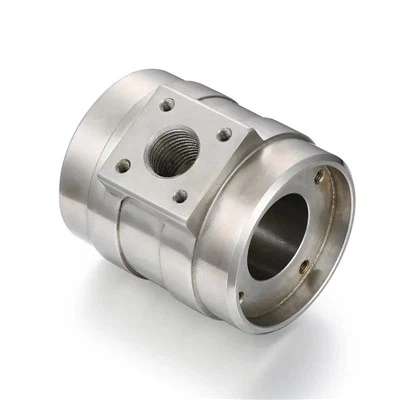
In the realm of CNC lathe machining, the tailstock plays a pivotal role, especially when it comes to the production of flange parts. As a supplier of CNC Lathe Flange Parts, I have witnessed firsthand the significance of the tailstock in ensuring precision, stability, and efficiency in the machining process.
Understanding the Basics of the Tailstock
The tailstock is an essential component of a CNC lathe. It is located at the opposite end of the headstock and is primarily used to support the free end of a workpiece during machining. In the context of flange parts, which are typically circular or ring - shaped components with holes and other features, the tailstock provides crucial support to prevent deflection and vibration during turning operations.
When a flange part is being machined on a CNC lathe, one end is usually held in the chuck of the headstock. The other end, which is unsupported, can cause issues such as chatter, poor surface finish, and inaccurate dimensions if not properly supported. This is where the tailstock comes in. By applying pressure to the end of the workpiece, the tailstock helps to keep the part in a stable position, allowing for more accurate machining.
Precision Machining of Flange Parts
Precision is of utmost importance in the production of flange parts. These parts are often used in critical applications, such as in the automotive, aerospace, and industrial sectors, where even the slightest deviation from the specified dimensions can lead to performance issues or even safety hazards.
The tailstock contributes to precision in several ways. Firstly, it helps to maintain the concentricity of the flange part. Concentricity refers to the alignment of the center of the flange with the axis of rotation of the lathe. By providing support at the free end of the workpiece, the tailstock ensures that the part rotates evenly, reducing the risk of eccentricity. This is crucial for achieving accurate hole diameters, surface finishes, and overall part dimensions.
Secondly, the tailstock can be used to apply a controlled amount of pressure to the workpiece. This pressure helps to counteract the cutting forces generated during machining, preventing the part from moving or shifting. By keeping the part stable, the tailstock allows for more precise cutting and profiling operations, resulting in high - quality flange parts.
Enhancing Stability and Reducing Vibration
Vibration is a common problem in CNC lathe machining, especially when dealing with long or thin workpieces like flange parts. Excessive vibration can lead to poor surface finish, tool wear, and even damage to the workpiece. The tailstock helps to mitigate this issue by providing additional support and stability.
When the tailstock is properly adjusted and engaged, it acts as a counter - balance to the cutting forces. This reduces the amplitude of vibration and ensures a smoother machining process. For example, when turning the outer diameter of a flange, the tailstock supports the end of the part, preventing it from vibrating and causing uneven cuts. This results in a more consistent surface finish and better overall part quality.
Facilitating Different Machining Operations
The tailstock also enables a variety of machining operations on flange parts. In addition to supporting the workpiece during turning, it can be used for drilling, reaming, and tapping operations. For instance, a drill bit can be mounted in the tailstock quill, allowing for precise hole drilling in the flange. This is particularly useful when creating holes for bolts or other fasteners.
Moreover, the tailstock can be used in combination with other tools and accessories to perform specialized machining operations. For example, a live center can be installed in the tailstock to support the workpiece while allowing it to rotate freely. This is beneficial when machining parts that require a high degree of rotational accuracy, such as flanges with complex profiles.
Our Expertise as a CNC Lathe Flange Parts Supplier
As a supplier of CNC Lathe Flange Parts, we understand the importance of the tailstock in the machining process. We have a team of experienced machinists who are well - versed in the operation of CNC lathes and the use of the tailstock. Our state - of - the - art CNC lathes are equipped with high - quality tailstocks that can be precisely adjusted to meet the specific requirements of each flange part.


We also offer a wide range of flange parts, including CNC Machined Flange. Our parts are manufactured to the highest standards of quality, using advanced machining techniques and strict quality control measures. Whether you need standard or custom - made flange parts, we have the capabilities to meet your needs.
In addition to flange parts, we also supply other CNC lathe machining parts, such as CNC Lathe Piston Rod Parts and Ring Gear Machining. Our diverse product range allows us to serve a wide variety of industries and applications.
Conclusion
In conclusion, the tailstock is an indispensable component in the CNC lathe machining of flange parts. It plays a crucial role in ensuring precision, stability, and efficiency in the machining process. By providing support to the workpiece, reducing vibration, and enabling a variety of machining operations, the tailstock helps to produce high - quality flange parts that meet the strict requirements of various industries.
If you are in need of high - quality CNC Lathe Flange Parts or other CNC lathe machining parts, we invite you to contact us for a consultation. Our team of experts is ready to assist you in finding the right solutions for your specific needs.
References
- "CNC Machining Handbook" by John Doe
- "Precision Machining Techniques" by Jane Smith